
What Happens During a Scalp Treatment, and Does Your Scalp Need One?
Updated October 2026
You exfoliate your face, apply serum, and wear sunscreen. But when was the last time you thought about your scalp? It is skin too, and it is the soil every strand of hair grows from. Between dry mountain air, hats and helmets, styling products, and strong sun at elevation, scalps in Pinedale put up with a lot.
A professional scalp treatment gives that skin the same attention you give your face. At June Beauty Lab, scalp care is designed to clear buildup, support a healthier environment for hair, and help with early thinning and shedding. Here is what to expect, who benefits most, and when your scalp needs a doctor instead.
What Is a Scalp Treatment?
A scalp treatment is a professional service that cleanses, exfoliates, and treats the skin on your head to support healthier-looking hair. Some focus on removing buildup, while others add active ingredients or growth factors to address thinning. The goal is a cleaner, calmer scalp that gives hair follicles a better environment.
Your scalp has more oil glands and hair follicles than most other skin on your body. When product residue, dead skin, and oil collect at the surface, the scalp can feel itchy, tight, or heavy, and hair may look flat or dull.
Signs Your Scalp Could Use Some Attention
Your scalp may benefit from treatment if it feels tight, dry, itchy, or coated, or if your hair seems to be shedding more than usual. Pay attention to how your scalp feels a day or two after washing, since that is when buildup and dryness are easiest to notice.
Common Signals
- Your scalp feels tight or dry, especially in winter
- Hair looks limp at the roots even right after washing
- You rely on dry shampoo several days a week
- You see more shedding in your brush or shower drain
- Your part looks wider, or your crown looks thinner
- You have a sunburned or peeling part after time outdoors
How Does Pinedale's Climate Affect Your Scalp?
Pinedale's low humidity and cold winters can leave the scalp dry and tight, while the sun at roughly 7,000 feet can burn an exposed part or thinning crown. The World Health Organization notes that UV levels increase with altitude because thinner air absorbs less radiation.
Local life adds its own challenges. Hours under a hunting cap, ski helmet, or sun hat trap heat and sweat. Long, hot showers on cold winter mornings can strip moisture further. A thoughtful scalp routine helps balance all of it.
What Happens During a Scalp Treatment at June Beauty Lab?
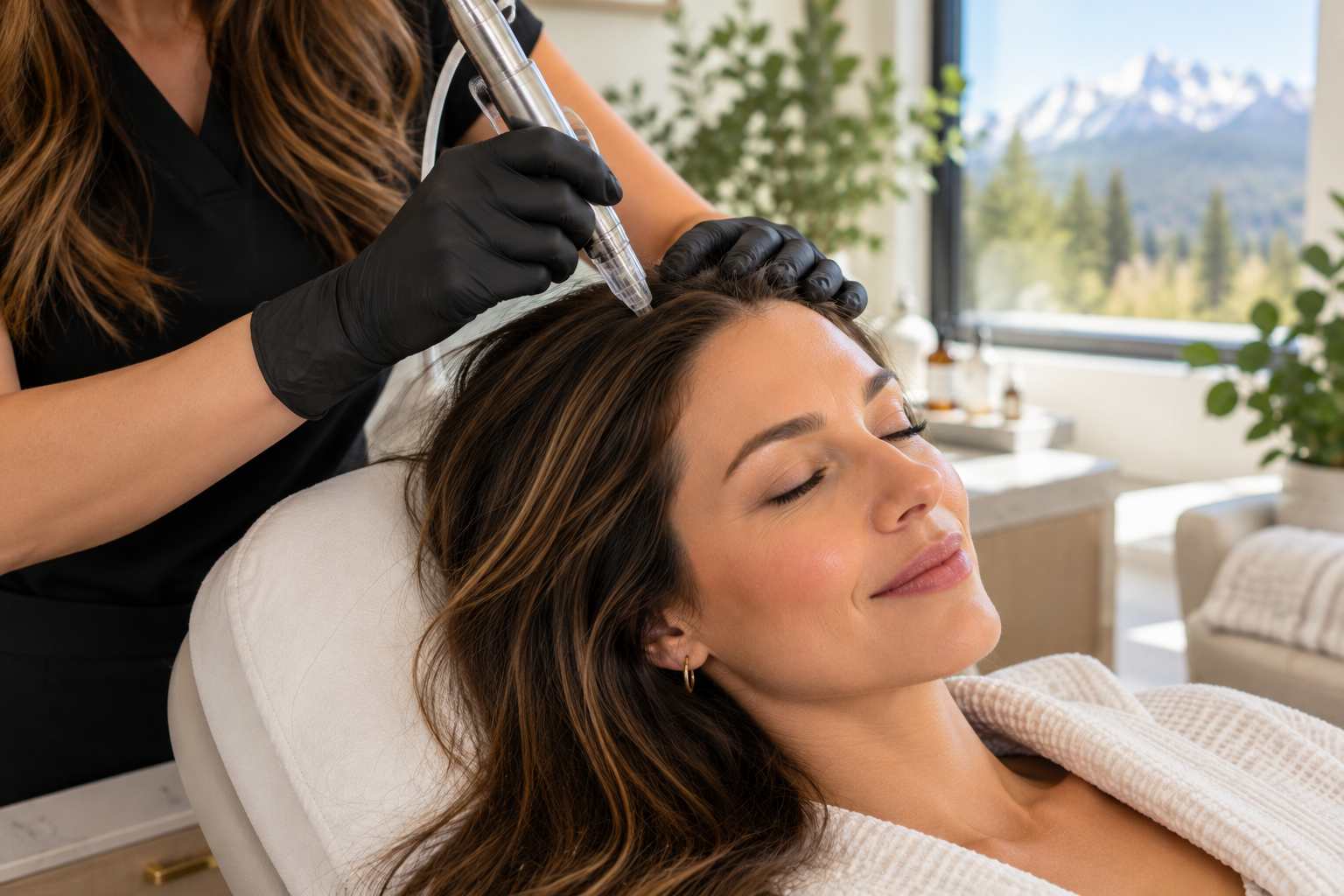
At June Beauty Lab, the in-clinic scalp treatment is DE|RIVE Hair Restoration. It begins with gentle cleansing or exfoliation to clear buildup, followed by a plant-based DE|RIVE serum applied directly to areas of thinning. Sessions take about 30 to 60 minutes, and there is no recovery time.
Step by Step
- Consultation. Your provider looks at your scalp, your hair pattern, and your history to understand what may be driving any changes.
- Cleansing or exfoliation. Buildup, oil, and dead skin are cleared so the scalp can better absorb what comes next.
- Serum application. The DE|RIVE serum is applied to thinning areas.
- Home care plan. You continue with an at-home serum between visits, with guidance on how to use it.
Sessions are usually spaced a few weeks apart. Some people notice less shedding and an improved scalp feel within a few weeks, while a fuller look typically takes three to six months of consistent treatment. Evidence for botanical scalp serums is still developing, so results vary.
Can a Scalp Treatment Be Combined With PRP or Microneedling?
Yes. Depending on your goals, DE|RIVE can be paired with PRP/PRF, which uses growth factors from your own blood, or with microneedling. These combinations involve needles and a bit more downtime, so your provider will help you decide whether they make sense for you. Research on PRP for hair is promising but mixed, and it is not FDA-approved for hair loss.
Who Benefits Most From Scalp Treatments?
Scalp treatments are best for adults with mild to moderate thinning, increased shedding, or a scalp that feels congested or dry, especially when follicles are still active. Men and women with a receding hairline, crown thinning, or lower overall density are common candidates.
Gen Z and Younger Adults
Dry shampoo, texturizing sprays, heat tools, and frequent coloring can leave the scalp coated and irritated. Many younger adults also notice early shedding and want to get ahead of it. A scalp treatment can reset buildup and pair well with gentler styling habits. If you wear tight ponytails or extensions often, giving your hairline a break matters too, since constant pulling can lead to lasting hair loss.
Men Noticing Early Thinning
Men often see changes at the temples and crown first. Early attention gives you the most options, and a scalp treatment can complement medical therapies your physician may recommend. Thinning areas are also more exposed to the sun, so a hat on the trail or the water is part of scalp care.
Busy Professionals Who Want Low-Maintenance Care
If your schedule is packed, a 30 to 60 minute session with no downtime fits easily into a lunch break or an afternoon off. You can head back to work right after, as long as you skip heavy styling for a day or two.
When Is a Scalp Problem Something a Doctor Should Treat?
See a dermatologist or medical provider if you have persistent flaking, redness, scaly patches, sores, pain, or round patches of hair loss. These can signal conditions like seborrheic dermatitis, psoriasis, a fungal infection, or alopecia areata, which need diagnosis and medical treatment.
The American Academy of Dermatology explains that seborrheic dermatitis, of which dandruff is the mildest form, often flares in winter and during stressful periods. That matters in a place with long, cold Wyoming winters. A cosmetic scalp treatment is not a substitute for medical care when a skin condition is involved.
Sudden or widespread hair loss can also point to thyroid issues, iron deficiency, hormonal changes, or a recent illness, so a medical evaluation is the right first step.
How Should You Care for Your Scalp After Treatment?
After a DE|RIVE session, keep your scalp clean and hydrated, use your at-home serum consistently, and skip harsh styling products, dry shampoo, and heavy oils for 24 to 48 hours. Avoid heat styling right after treatment and protect your scalp from direct sun.
Daily Habits That Support a Healthy Scalp
- Wash with lukewarm rather than very hot water
- Massage your scalp gently while cleansing instead of scratching
- Use dry shampoo sparingly and wash it out regularly
- Wear a hat for long days outdoors, especially at altitude
- Run a humidifier during dry winter months
- Choose looser hairstyles when you can
Scalp Treatment Questions, Answered
How often should you get a scalp treatment?
DE|RIVE sessions are usually spaced a few weeks apart, with the total number based on your goals and how your scalp responds. Your provider sets the schedule during your consultation.
Does a scalp treatment help with hair growth?
A scalp treatment can support a healthier environment for hair and may reduce shedding, and some people see fuller-looking hair over three to six months. It cannot guarantee regrowth, and it works best when any underlying medical cause is also addressed.
Is a scalp treatment painful?
DE|RIVE on its own is non-invasive and comfortable for most people. If it is combined with PRP or microneedling, numbing is used and you may feel mild pressure or tenderness.
Can a scalp treatment fix dandruff?
Dandruff and seborrheic dermatitis are skin conditions best managed with medicated products or treatment from a dermatologist. A cosmetic scalp treatment is not designed to treat them.
Your Scalp Deserves a Little High-Altitude TLC
Your scalp works hard in Pinedale's dry, sunny climate, and giving it some focused care can make a real difference in how your hair looks and feels. At June Beauty Lab, scalp treatment starts with understanding what is happening beneath the surface, then building a plan that is honest about what it can and cannot do.
Ready to give your scalp the attention it deserves? Book online or contact the Lab at 128 W Pine Street. Explore scalp care, learn more about hair thinning, and discover all the services at June Beauty Lab.